REVIEW · ROME
Rome: Private Night Ghost Walking Tour
Book on Viator →Operated by Carpe Diem Tours · Bookable on Viator
That sound you hear at night isn’t always just footsteps. I love the way this night route turns famous squares into living stories, and I love that it blends iconic sights with quieter lanes. One thing to think about: at $179.74 per person, it’s best when you’re going with a group or really want a guided “dark Rome” focus.
You start at Campo de’ Fiori and end at Castel Sant’Angelo, so the arc of the evening feels natural—center-city drama first, river views and a big finish at the end. Guides like Csenge, Maham, Dina, Sarah, and Diletta have been praised for keeping things engaging, so you’re not just walking between stops and reading signs. If you prefer gentle folklore over anything grisly, you’ll still be fine, but you should know the themes lean serious and macabre.
This is a 2-hour walking experience in English, capped at 20 travelers, with a mobile ticket you can keep on your phone. It also starts at 8:30 pm, which means you dodge most of the midday heat and the crush of daytime tour groups.
In This Review
- Key things that make this ghost tour worth your time
- Why a late 8:30 pm ghost walk feels better than daytime Rome
- The route from Campo de’ Fiori to Castel Sant’Angelo: what the evening is really doing
- Campo de’ Fiori, Piazza Farnese, and the “little madonnas” that stop trouble
- Ponte Sisto and Fontana del Mascherone: bridge horror and fountain rules
- Chiesa di Santa Maria dell’Orazione e Morte: human remains in plain sight
- Monserrato’s prison street stories and the Spanish church’s scandal plot
- Via Giulia and the cosmetics-can-kill story
- Via dell’Arco dei Banchi and the childhood home of Rome’s infamous executioner
- Castel Sant’Angelo at the end: angels, warnings, and a strong finish by the river
- Guides and group energy: why names like Csenge and Diletta matter
- Price and value: is $179.74 per person a smart choice?
- Who should book this Rome ghost walking tour?
- Should you book this private night ghost walking tour?
- FAQ
- What time does the tour start?
- How long is the Rome night ghost walking tour?
- Where do I meet the tour guide?
- Where does the tour end?
- Is the tour in English?
- What is the maximum group size?
- Do I get a mobile ticket?
- Is there free cancellation?
- Are service animals allowed?
Key things that make this ghost tour worth your time
- A smart evening start (8:30 pm) for cooler walking and fewer crowds than daytime sightseeing
- A tight route with a clear finish: from Campo de’ Fiori to Castel Sant’Angelo by the river
- Big storytelling stops like Ponte Sisto and Castel Sant’Angelo, plus smaller, more eerie side streets
- Death-linked landmarks get explained in a way that’s visual and easy to follow
- Up to 20 people max, so it feels small rather than mass-group
- English-speaking guides with a track record of keeping the group engaged
Why a late 8:30 pm ghost walk feels better than daytime Rome
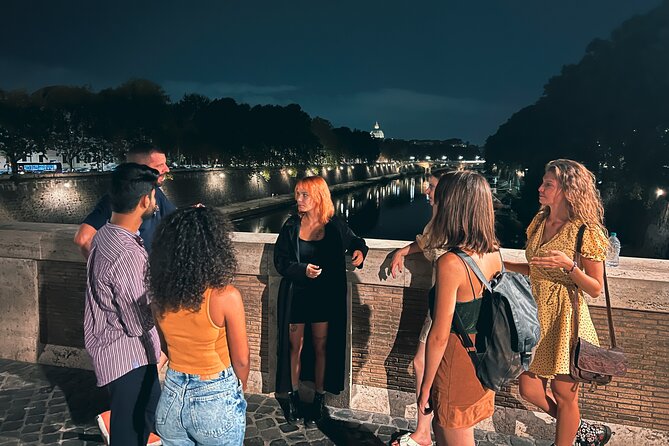
Rome is beautiful in the daylight, but at night it becomes a different animal. This tour’s 8:30 pm start helps you avoid the hottest hours and the densest crowds, so you can actually hear the guide and enjoy the mood.
There’s also a practical side: you’re walking through central neighborhoods when the energy shifts. The streets and piazzas still look like Rome, but the context changes. Stories about executions, prisons, and scandal land better when the buildings are darker and quieter.
The pacing matters, too. With an approximate 2-hour duration and lots of short stop moments (around 10 minutes each), you get enough time to absorb each location without feeling stuck at one spot forever. It’s a walking tour style that works well if you want history with momentum.
You can also read our reviews of more tours and experiences in Rome.


The route from Campo de’ Fiori to Castel Sant’Angelo: what the evening is really doing
You’ll begin in Piazza Campo de’ Fiori and end at Castel Sant’Angelo on Lungotevere Castello. That matters because the route isn’t random. You’re moving from a central “stage” area into surrounding streets that feel more lived-in, and then you close with a landmark that naturally frames the river and the night sky.
Along the way, the tour mixes places most visitors recognize with others that are easy to overlook. One moment you’re at a famous square; the next you’re learning why a specific corner, church, or building has a dark reputation.
This mix is the whole point. If you only chase the “greatest hits,” you miss what gives Rome its texture. If you only wander on your own, you may get lost in general impressions. Here, you get direction plus atmosphere—exactly the combo that makes a theme tour click.
Campo de’ Fiori, Piazza Farnese, and the “little madonnas” that stop trouble
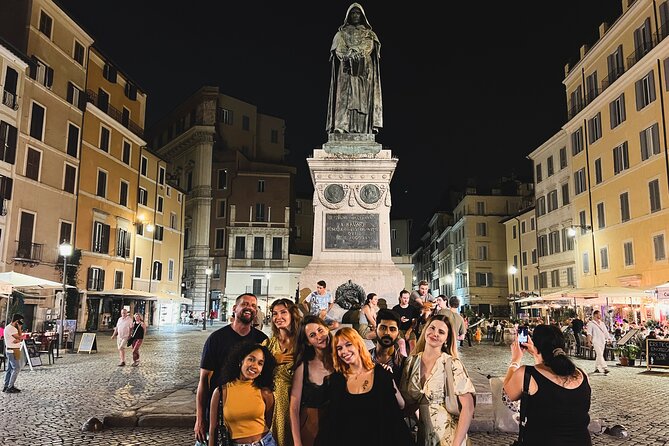
The evening opens in Campo de’ Fiori, one of Rome’s most recognizable piazzas. Today it’s known for lively bars and restaurants, but it was once tied to executions—so the setting immediately creates contrast. Your guide starts you off with that darker context, and suddenly the square feels less like a postcard stop and more like a story you can walk through.
Next comes Piazza Farnese. This square is associated with elite parties and lavish power, but the darker side is the focus—scandals and secrets. That shift is useful for your brain. It prevents the tour from becoming one-note “spooky Rome.” You’re learning how different social layers connect to the city’s worst eras.
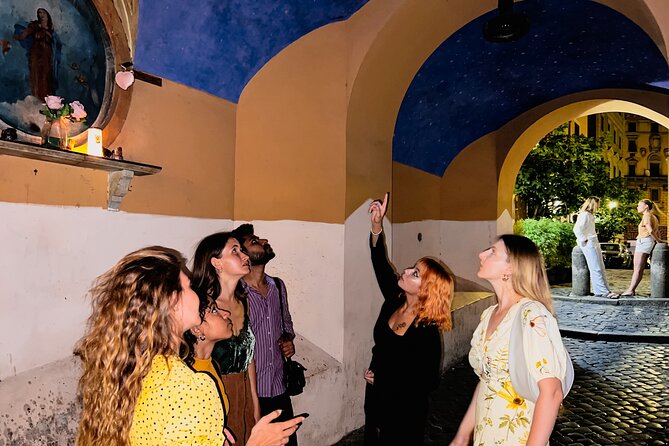
Then you head toward Via del Mascherone & Vicolo dei Venti. This section is where the tour earns its charm. You’ll spot madonelles—small Madonna figures—and learn their former function as crime-stopping statues. Even if you’ve seen icons like this before, having a reason behind them changes how you look at them. Instead of decoration, you’re seeing old “protection” placed right where people could walk past it.
If you like walking tours that teach you to notice details, this early stretch is a strong start. The only drawback is that this is also when you’re still settling into the theme, so if you’re very tired right after travel, give yourself a minute to get into the groove.
Ponte Sisto and Fontana del Mascherone: bridge horror and fountain rules
Ponte Sisto is the kind of stop that makes the tour feel cinematic. It’s described as Rome’s oldest bridge, and the stories around it are about power struggles, theft, accidents, suspicious deaths, and tragic outcomes. A bridge is a perfect place for these tales because it’s a connector—people cross it, stories travel with it.
This is also one of the stops where you’ll likely feel the benefit of a guide. Without explanation, you might see a historic bridge and move on. With the tour’s framing, you’ll start imagining the human fallout tied to daily movement—who used the bridge, what happened there, and why the city remembered.
Then you reach Fontana del Mascherone. Here the tone turns from “history” to “legend with consequences.” The rule is simple: drinking from fountains in Rome is illegal, but drinking from this one is said to be deadly. It’s not presented like a casual scare; it’s part of why this place has a reputation.
You don’t need to believe every detail to enjoy it. The value is that you understand why legends stick in certain spots—and how the city turns everyday objects into warnings.
Chiesa di Santa Maria dell’Orazione e Morte: human remains in plain sight
Chiesa di Santa Maria dell’Orazione e Morte is the tour’s most direct “don’t look away” moment. This 17th-century church is decorated in human remains, and it’s framed as a reminder that death is closer than it feels.
That’s the key phrase to keep in mind: reminder. This isn’t just shock value. It’s a historical mindset made visible—one where mortality is part of daily religious and social thought. You’ll walk into that atmosphere knowing what you’re looking at, which makes the experience easier to process.
Practical note: churches can be chilly and dim. Even if you’re dressed for a warm summer evening, bring a layer you can tolerate if the temperature drops once you step indoors.
This is also a stop that can shift your comfort level quickly. If you’re traveling with kids, you might want to gauge their interest in spooky themes before choosing a tour with explicitly death-related décor. The good news is the tour is short at each stop (around 10 minutes), so you’re not stuck in one intense location for a long stretch.



Monserrato’s prison street stories and the Spanish church’s scandal plot
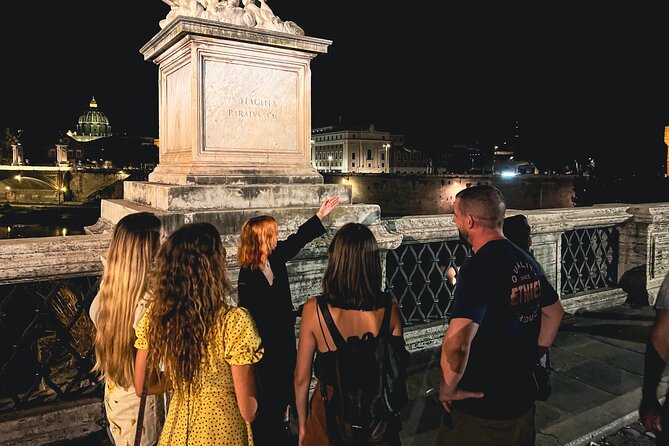
Via di Monserrato brings the theme into a darker, more grounded lane. The tour links this apartment block to one of the worst prisons in Italy’s history, with a haunted reason attached to it. Even without digging into dates, the setting helps you feel the story: you’re standing where confinement happened, not just reading about it.
Then you visit Chiesa di Santa Maria in Monserrato degli Spagnoli. This Spanish church comes with a scandalous story described as worthy of a telenovela. That detail matters because it tells you how the guide likely builds the narrative: characters, conflict, and consequences—rather than a dry list of facts.
A tour like this works best when it mixes tones. One minute you’re confronting grim architecture and punishment; the next you’re getting plot-like storytelling around power and scandal. That’s one of the reasons people keep returning to this kind of evening walk.
Via Giulia and the cosmetics-can-kill story
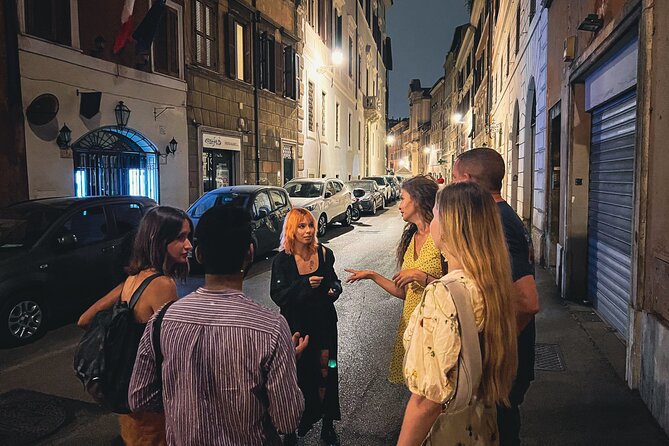
Via Giulia is where the tour taps into something surprisingly relatable: beauty culture with a deadly edge. You’ll learn about when cosmetics can kill, framed through the idea of a former beauty shop and what that implied back then.
This stop is more than a creepy twist. It gives you a new lens for Rome—one where everyday activities (beauty, reputation, display) connect to risk and consequence. It also breaks up the darker stops with something that sounds familiar enough to grab attention quickly.
If you’re the type who likes tours that connect “then” to “now,” this is the one that tends to land well. The drawback is that if you’re expecting only execution-and-ghost vibes, you might find this section feels more story-driven and less overtly scary.
Either way, it’s a nice tonal reset before you move into the executioner connection and the big finale.
Via dell’Arco dei Banchi and the childhood home of Rome’s infamous executioner
Via dell’Arco dei Banchi is presented as a normal house on the surface—but it’s tied to the childhood home of Rome’s most infamous executioner. That contrast is the magic here. Rome is full of buildings that look calm, even innocent, while the stories attached to them can be brutally dark.
This is a great stop for anyone who loves the idea of learning why a place feels the way it does. A house is private. A childhood home is intimate. When a guide connects that intimacy to public violence, your perspective shifts fast.
The same theme keeps repeating throughout this tour: what you see today is only one layer. The guide helps you add the missing layers—the human choices, the power games, and the consequences that made certain spots infamous.
Castel Sant’Angelo at the end: angels, warnings, and a strong finish by the river
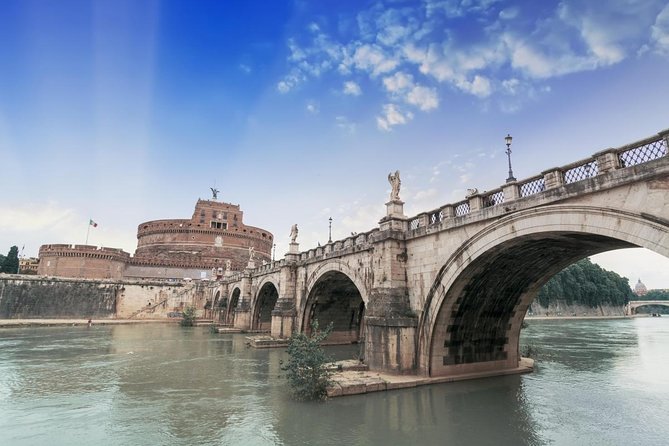
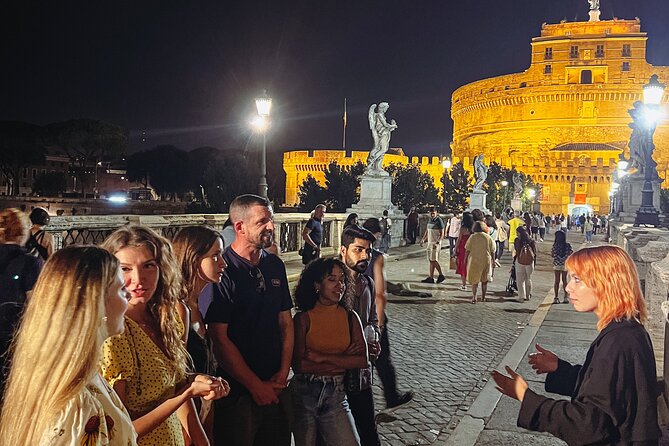
You wrap up at Castel Sant’Angelo, and the tour’s theme meets its grand scale here. The bridge used to expose bodies of the executed as a warning to sinners, and now the area is surrounded by statues of angels. That contrast can feel almost surreal.
You’ll also hear the story of the Cenci family and how they met a bloody end. It’s the kind of ending that sticks in your head because it’s dramatic but rooted in a specific setting. You finish near the river as well, so if you want to keep the evening going, you can do it with views and a natural place to wander afterward.
This end point is practical, too. Castel Sant’Angelo is a solid landmark for finding your way onward—whether you’re heading to dinner nearby or walking off the route at your own pace.
Guides and group energy: why names like Csenge and Diletta matter
The tour experience depends heavily on storytelling, and the guides associated with the tour have been praised for that exact thing. People mention Csenge, Maham, Dina, Sarah, and Diletta by name, and they’re described as enthusiastic, knowledgeable, and genuinely entertaining.
More importantly, they keep the group engaged. That doesn’t sound like a big deal until you’re outside for two hours with multiple stops. A good guide manages the flow—calls attention to details at the right moment, keeps the group together, and makes each stop feel connected to the next.
Also, the group size cap of 20 helps. Big groups tend to dilute the effect of a walking theme tour. A smaller cap lets the guide work the room, not just the itinerary.
One consideration: the tour is offered in English, so if your group’s English level is limited, you might want to double-check that it’s comfortable for everyone. The tour is designed for most travelers, but language comfort is what keeps the scares fun instead of frustrating.
Price and value: is $179.74 per person a smart choice?
At $179.74 per person for an approximately 2-hour walking tour, this isn’t the cheapest way to see Rome at night. So you should be honest about what you’re paying for.
You’re paying for:
- a guided narrative that turns ordinary corners into a coherent “dark Rome” story
- a route that goes beyond the usual sightseeing checklist
- evening timing that makes walking easier and more pleasant
- an English-speaking guide who’s been praised for both knowledge and entertainment
The best value is when you’re traveling as a group and can use any group discounts available for your party size. If you’re going solo, the price can feel steeper because the experience isn’t being “shared” across multiple travelers in the way a cheaper small-group tour might be.
My advice: if you want themed storytelling and you like history with an edge, this price starts to make sense. If you’d rather roam independently and read about sites later, you might feel you can DIY for less.
Who should book this Rome ghost walking tour?
Book it if you:
- want a night alternative to daytime sightseeing
- enjoy dark legends, true-crime energy, and moral warning stories
- like walking tours with short stop segments and strong guide narration
- are traveling with friends, teens, or adults who enjoy spooky history
- want a route with a clear start (Campo de’ Fiori) and finish (Castel Sant’Angelo)
Skip or reconsider if you:
- dislike macabre themes or human remains-related stops
- need a very mild, family-friendly route with minimal intensity
- prefer long indoor time at museums over outdoor walking
Should you book this private night ghost walking tour?
If you’re choosing one “theme” tour in Rome, this is a strong candidate—especially because the timing is good and the route has a clear shape. I like that it’s not only famous stops. It also sends you into streets and small spaces where Rome feels less like a museum and more like an old city with memory.
At the same time, it’s priced like a premium guided experience. If you’re on a tight budget, you can get Rome’s sights cheaper on your own. But if you care about the story behind the stones—and you want a guide who can keep the group moving while making each stop matter—this is the kind of evening that earns its ticket price.
FAQ
What time does the tour start?
The tour starts at 8:30 pm.
How long is the Rome night ghost walking tour?
It lasts about 2 hours.
Where do I meet the tour guide?
The meeting point is Piazza Campo de’ Fiori, P.za Campo de’ Fiori, 00186 Roma RM, Italy.
Where does the tour end?
The tour ends at Castel Sant’Angelo, Lungotevere Castello, 50, 00193 Roma RM, Italy.
Is the tour in English?
Yes, it’s offered in English.
What is the maximum group size?
The maximum is 20 travelers.
Do I get a mobile ticket?
Yes, it uses a mobile ticket.
Is there free cancellation?
Yes. You can cancel up to 24 hours in advance for a full refund.
Are service animals allowed?
Yes, service animals are allowed.