A smartphone hunt through Turin beats the usual stroll. This is an outdoor escape-game tour where you solve clues on your phone while picking up eerie local stories, all at your own pace. The big win for me is that it’s offline, so you can keep moving without hunting for signal.
I also like that it’s flexible: start any hour, take a break, and resume later—no guide herd, no waiting around. The one real consideration is that it’s phone-dependent; if the game won’t activate, you’ll need to contact [email protected] and troubleshoot, since there’s no human guide waiting in person.
In This Review
- Key things to know before you go
- Why this game-style tour feels different from a normal walk
- Price and Logistics: where you start, where you end, and what the route really means
- Stop 1: Piazza Statuto and the story behind the Black Heart name
- Santuario della Consolata: a Marian sanctuary and a clue-hunt intersection
- Rondò della Forca: esoteric Turin at a precise road meeting
- Palatine Gate: Roman Turin’s best-preserved entrance
- Madama Palace: ducal widows, senate years, and today’s museum
- Piazza Castello and the arcaded Via Po: where the city’s brains and coffee meet
- Piazza San Carlo and Palazzo Trucchi: Baroque squares and a door you can’t miss
- The finishing act on the Po: Ponte Vittorio Emanuele I
- When the app gets technical: handling activation problems
- Who should book Ghosts of Turin, and who might not love it
- Should you book Ghosts of Turin: Hidden Spell Exploration Game?
- FAQ
- How long is the Ghosts of Turin exploration game?
- Where does the game start and where does it end?
- Can I start the game at any time?
- Do I need an internet connection to play?
- Is there a physical tour guide with you?
- Is this experience private?
- What’s included in the experience?
- How much does it cost?
- Are mobile tickets used?
- Is it possible to get a full refund if plans change?
Key things to know before you go
- Offline play while exploring means you can keep going even if your phone signal is weak.
- Start anytime, 24/7 lets you fit it around museums, meals, and jet lag.
- Step-by-step directions help you move between stops without getting lost.
- A blend of tour + escape game + treasure hunt keeps the walk from feeling like “just sightseeing.”
- Private setup for your group means you won’t be squeezed into someone else’s pace.
- Phone activation is the weak point to plan around in advance (battery, device readiness).
Why this game-style tour feels different from a normal walk
Turin can be a lot of stone-and-facts tours. This one takes a different approach. Instead of a guide talking at you, you’re following missions on the Questo app. Each stop is a “find the answer” moment tied to a local mystery or layered past. It turns the city into a puzzle you’re solving in real time.
What I like most is that the walking stays guided. You’re not left with a map and good luck. The app directs you between locations so you don’t end up pacing in circles, especially if you’re doing this at night or in a rain shower. And because it’s meant to run offline, you’re not hostage to spotty data.
The pace also works for different styles. You can move fast and hit all the stops, or slow down to read what you find and take your time. A 1 hour 30 minutes estimate is given, but the whole point is that you can pause and resume.
Price and Logistics: where you start, where you end, and what the route really means
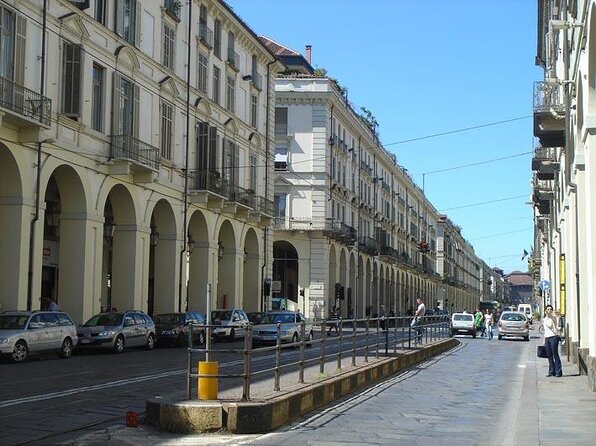
The price is $8.11 per person, which is surprisingly low for a guided-by-an-app route through central Turin. You’re paying for the structure: the clue chain, the directions, and the “what to look for” at each location—without paying for a human guide.
Where you start: Piazza Statuto.
Where you finish: Ponte Vittorio Emanuele I.
That start-to-finish flow matters. You’re not doing a closed loop where you retrace your steps the same way. You end on the Po river side, so once you finish, it’s easier to keep exploring nearby on your own.
You’ll also want to plan around the fact that you need your phone for everything. This is a mobile ticket experience with mobile check-in in the app world. Since it’s available from midnight to late evening every day, you can slot it in for your best time window. Near public transportation is a bonus if you want an easy arrival and a smooth departure after the game ends.
Stop 1: Piazza Statuto and the story behind the Black Heart name
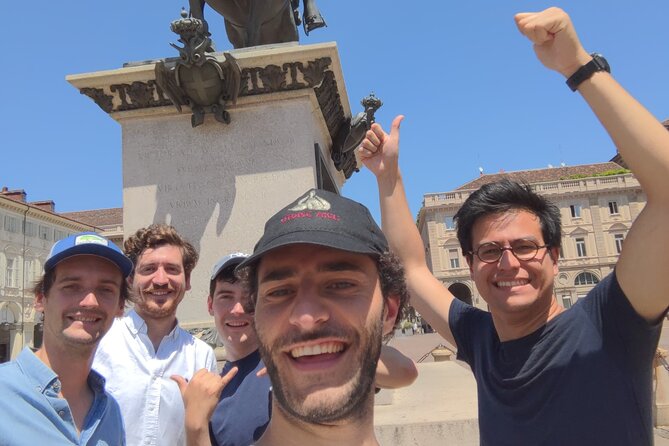
You begin at Piazza Statuto, and the game immediately sets the tone with history that’s darker than most postcards. This square has worn a few identities: a Roman necropolis, a French execution site, and a terrible fire in 1983. In the center, the fountain is tied to the workers who died digging the Frejus Rail Tunnel. Because of that fatal legacy, the area has picked up the “Black Heart” title.
For the puzzle, you’re not just reading a sign. You’ll be looking around to find the answer that unlocks the next location. That’s the core trick of this experience: you learn by actively noticing instead of passively absorbing.
How it helps your visit: you get your bearings fast, because the game nudges you to look closely at your surroundings rather than just crossing the square. It also gives you a reason to be there beyond “it’s a landmark.”
Small drawback: this kind of outdoor scavenger start can feel slightly chaotic if you arrive with a low battery or a phone that’s slow to cooperate. I’d treat the first five minutes like the most important part.
Santuario della Consolata: a Marian sanctuary and a clue-hunt intersection
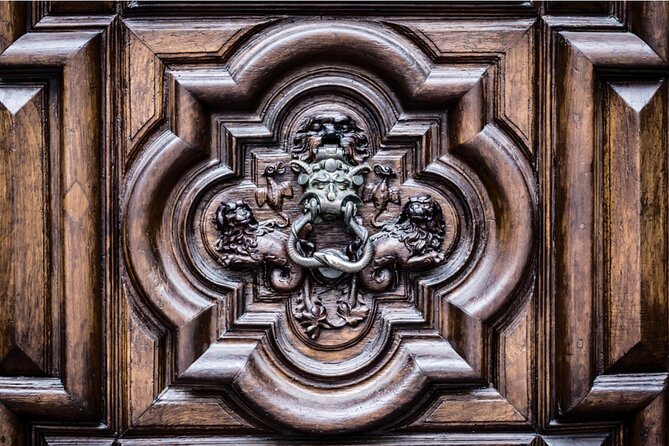
Next up is the Santuario della Consolata, also known by the familiar nickname La Consla. It’s a prominent Marian sanctuary and minor basilica in central Turin, sitting at the intersection of Via Consolata and Via Carlo Ignazio Giulio.
The game’s approach stays the same: you’ll look around to find the answer to a challenge that moves you forward. Here, that works well because churches and sanctuaries reward close attention—architecture details, inscriptions, and the general “feel” of the place all become part of your search.
What you’ll likely enjoy here: the mix of mood. You’re going from a square with grim layers to a sanctuary that’s a central spiritual stop. That contrast keeps the game from feeling like one long “dark story” theme. Even if you’re not religious, you’ll still appreciate how the place functions in the city.
Practical tip: give yourself enough time to stop at the right points. The app is step-by-step, but you still need to be standing in the correct area to notice what the clue is pointing to.
Rondò della Forca: esoteric Turin at a precise road meeting
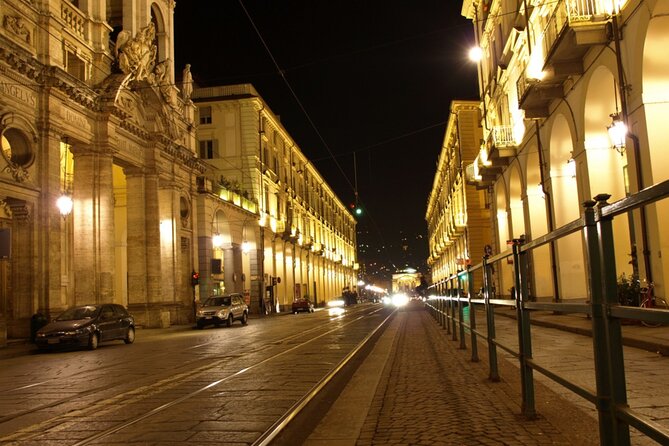
If you’ve ever heard of esoteric Turin, Rondò della Forca is a name that comes up. The key detail is that it refers to a precise point: the area formed where the Valdocco, Principe Eugenio, and Regina Margherita courses meet via Cigna. It’s not far from Piazza dello Statuto, which makes it a good mid-route connector.
This stop is mostly about orientation—finding the exact junction and then spotting what the game wants you to notice. It’s the kind of place where you might think, “How do I turn a road roundabout into a mystery?” That’s exactly what the game style solves. Instead of being frustrated by traffic geometry, you get a mission that makes the location meaningful.
Why it’s valuable: it adds a different Turin lens. Not the obvious grand-sight one, but the one focused on odd corners and local lore. The “learn while you search” format is what makes it work.
Palatine Gate: Roman Turin’s best-preserved entrance
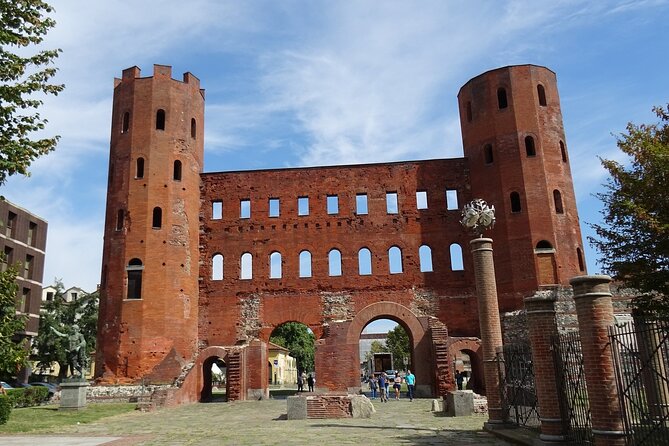
Then you hit something that’s not just atmospheric—it’s tangible archaeology. The Palatine Gate is the main archaeological evidence of Turin’s Roman phase, and it’s described as one of the best-preserved 1st-century BC Roman gateways in the world. It’s part of the Archaeological Park opened in 2006, and there are ancient theatre remains nearby.
Because the game has you looking for answers, you’re likely to slow down and pay attention to the gateway itself, not just glance and move on. That’s a big advantage. Roman ruins can disappear if you walk too fast. A mission stops you from doing that.
What you should watch for: the way the site is framed within the broader archaeological area. Even if you don’t go inside everything available, the gateway is a strong “marker” that makes the route feel anchored and real.
Madama Palace: ducal widows, senate years, and today’s museum
Madama Palace starts in the 13th century and carries a name connected to the resident widows of the 17th-century dukes of Savoy. Later, the building served political roles: the Sardinian Senate from 1848 to 1860, then the Italian Senate from 1861 to 1864. Today, it houses the Museum of Ancient Arts.
This stop is a good example of how the game format can keep you interested in a big, layered building. You’re not just thinking about dates; you’re uncovering the “why this place is called what it’s called,” and how power shifted over time.
How the puzzle experience adds value: it turns a grand palace facade into a story you’re actively linking to details. Even if you only catch what’s visible from outside, you’ll leave with a clearer mental picture of the building’s roles.
Piazza Castello and the arcaded Via Po: where the city’s brains and coffee meet
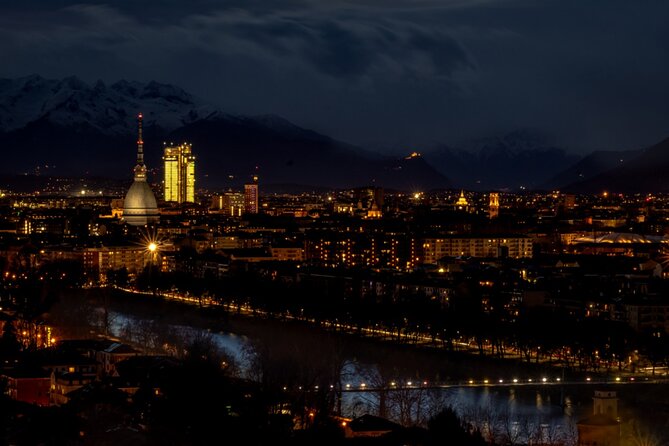
Piazza Castello is a central square lined with museums, theaters, and cafes. It’s also the kind of place where, without a plan, you can lose time hopping between doors. The game keeps you moving toward the next clue moment.
From there, the route includes Via Po with its famous arcades, built by Amedeo di Castellamonte in 1868. Along this street you’ll find details that matter if you like urban texture: the first and original building of the University of Turin and the historical Caffè Fiorio.
Why this works as a game stop: arcades and long streets can feel boring if you’re just walking. Here, the clue activity gives you a reason to pause, scan, and notice the buildings that define the street’s character.
A small consideration: if you’re the type who loves sitting in cafes for an hour, this part may feel like the game is moving you faster than you want. You can always pause the experience and resume, but know what kind of traveler you are before you start.
Piazza San Carlo and Palazzo Trucchi: Baroque squares and a door you can’t miss
Piazza San Carlo is one of Turin’s main squares. It was laid out in the 16th and 17th century and is an example of Baroque style. Its current name honors Charles Borromeo, though it previously went by names like Piazza Reale, Piazza d’Armi, and Place Napoleon.
Right along the way is Palazzo Trucchi di Levaldigi, noted for its massive wooden door commissioned in the 17th century by the Earl of Trucchi di Levaldigi. This is exactly the sort of “look closely” stop that rewards the game format. A door that big is hard to ignore, and a mission makes you stop long enough to actually register what you’re seeing.
How to get the most out of these stops: don’t rush them. The game wants you to look around, and these are places where the “around” includes architectural proportions, street alignment, and how buildings frame the square.
The finishing act on the Po: Ponte Vittorio Emanuele I
Your end point is Ponte Vittorio Emanuele I. It’s described as the oldest existing bridge in Turin and also one of the most beautiful and important. A crossing here has always mattered for the city, and between the 15th and 19th centuries it was one of the main gateways into Turin.
Ending on a bridge gives the route a clean feeling. You’ve been moving through squares, sanctuaries, and palaces. Now you end at a crossing that connects the whole story together with the geography of Turin.
Why it’s a satisfying finish: even if you don’t read every detail, the bridge location helps you “see” Turin as a connected system—streets lead to squares, squares lead to history, and history leads to the river.
When the app gets technical: handling activation problems
One real-world downside showed up in a past experience: the game didn’t activate due to a technical issue. Assistance was requested via chat, but the issue couldn’t be resolved immediately, and a phone number provided for contact didn’t get answered.
Here’s the practical fix you can take seriously: if you hit activation trouble, email [email protected] with all details so they can assist you. And before you start, do the boring stuff that prevents drama—make sure your phone is charged and that the app is ready to run the moment you begin.
The key thing: there’s no physical guide waiting to “rescue” your route. You’re the backup plan, which is why a smooth start matters.
Who should book Ghosts of Turin, and who might not love it
You’ll probably like this if you:
- enjoy problem-solving on walks
- want a self-guided route that avoids crowds and guide schedules
- prefer learning through observation rather than listening for two hours
- travel with your own timing, not a group’s
You might not love it if:
- your phone is unreliable or you’re traveling with limited battery life
- you hate puzzle-style instructions
- you want a classic sit-and-learn guided experience with a human interpreter
Also, it’s private for your group. That’s great if you want quiet focus. It can also be less great if you were hoping for interaction with a person, since the experience is designed around no human contact.
Should you book Ghosts of Turin: Hidden Spell Exploration Game?
If you want a low-cost way to cover central Turin with purpose, I’d say yes—with one big caveat: treat the phone side as part of the plan. At $8.11 per person for about 1 hour 30 minutes of structured sightseeing, it’s a strong value, especially because it works offline and runs 24/7. The route also hits a very Turin mix: Roman archaeology, a Marian sanctuary, esoteric lore, palaces, and the Po river finish.
If your device behaves and you don’t mind that the experience is mission-driven, you’ll likely find it one of those walks that feels like you’re cheating the city—getting stories and context without a formal tour structure.
FAQ
How long is the Ghosts of Turin exploration game?
It’s listed at about 1 hour 30 minutes.
Where does the game start and where does it end?
It starts at Piazza Statuto, Torino TO, Italy, and ends at Ponte Vittorio Emanuele I, 10124 Torino TO, Italy.
Can I start the game at any time?
Yes. It’s described as permanently available 24/7, and you can start at any hour.
Do I need an internet connection to play?
No. You can play offline while exploring.
Is there a physical tour guide with you?
No. It’s designed with no human contact, so you only need your phone.
Is this experience private?
Yes. It’s described as private, with only your group participating.
What’s included in the experience?
Included features are full flexibility (start at any hour, break and resume), a safe format with no human contact, permanent availability, and the option to play offline.
How much does it cost?
The price is listed as $8.11 per person.
Are mobile tickets used?
Yes. It includes a mobile ticket.
Is it possible to get a full refund if plans change?
Yes. Free cancellation is offered, and you can cancel up to 24 hours in advance for a full refund.