REVIEW · MUNICH
Ghosts of Munich: The Haunted Apprentice Exploration Game
Book on Viator →Operated by Questo · Bookable on Viator
One city. One phone. And plenty of spooky questions. Ghosts of Munich turns central Munich into a self-guided adventure game with haunted stories and on-the-spot challenges. Odeonsplatz to Marienplatz, it’s a route you can handle on your own time, with offline play keeping your trip easy on data.
I like how this is genuinely self-paced. You can start whenever you want, pause for breaks, and resume later without feeling trapped in a group schedule. And for sightseeing, it’s a strong mix of big public squares plus major church interiors—so you’re not just answering questions, you’re actually seeing Munich.
The main drawback to consider is that some stops don’t include admission or entry. You may need to pay separately if you want to go into certain churches, towers, or the New Town Hall area. Also, because it’s app-based, you’ll want your phone ready before you begin.
In This Review
- Key things to know before you play
- A haunted walking game that still feels like real Munich
- Price and what you get for $7.21
- Where you’ll start and how the route flows
- Stop-by-stop: the haunted route across Munich’s core
- Stop 1: Odeonsplatz (the 1921 checkpoint)
- Stop 2: Hofgarten (roses, power, and a quiet chill)
- Stop 3: Theatine Church of St. Cajetan (baroque contrast inside)
- Stop 4: Sitzender Keiler (the Sitting Boar luck ritual)
- Stop 5: Frauenkirche (the devil’s footprint at the entrance)
- Stop 6: Marienplatz (where city power and chaos meet)
- Stop 7: St. Peter’s Church (800 years of rebuilds)
- Stop 8: New Town Hall (Neus Rathaus) and the final clue)
- Offline play: how it changes the experience
- Crowd control without a guide breathing down your neck
- Best for families, couples, and small groups who like to look closely
- When you might hit friction
- Quick FAQ
- FAQ
- Is the Ghosts of Munich game available in English?
- Can I play it without a physical guide?
- Does it work offline to avoid data charges?
- How long does the experience take?
- Are all entrance tickets included?
- Can I start at any time and take breaks?
- Should you book Ghosts of Munich?
Key things to know before you play

- Offline access means fewer worries about data while you walk.
- English audio stories keep the pace moving even if you’re not fluent in German.
- Private self-guided play helps you dodge crowd pressure at popular landmarks.
- A tight 1 to 2 hour route works well as a standalone activity or a pre-dinner plan.
- Some entry is not included, especially at major churches and viewpoints.
- Teamwork and observation fit this format, which is great if you’re traveling with teens or a small group.
A haunted walking game that still feels like real Munich
Ghosts of Munich is one of those ideas that sounds gimmicky until you do it. The app-driven format guides you from place to place with short story checkpoints and small challenges, so you stay focused while walking. The best part is that it doesn’t replace sightseeing—it turns sightseeing into your game board.
For value, I especially like the price point. At $7.21 per person, you’re paying for the storytelling, prompts, and offline experience—not for a fancy private guide’s hours. If you like exploring with momentum (and a reason to look closely at details), it’s a good match.
You can also read our reviews of more tours and experiences in Munich.


Price and what you get for $7.21
This is priced like a budget-friendly attraction, and that fits the format. You’re not buying a full guided tour with a person talking nonstop. You’re buying a mobile, audio-based adventure that gets you moving through central sights for about 1 to 2 hours.
Here’s how I’d think about value:
- If you enjoy light games on walks, the price is easy to justify.
- If you only want passive sightseeing, you might feel less engaged by the “find the answer” style.
- If you plan to visit paid viewpoints anyway (like church towers), the “not included” admission parts may not change your plans much. If you were hoping everything is bundled, check the stops that list tickets as not included.
It’s also good for flexible travel. The experience can be played any time after booking, and you can pause for breaks. That matters in Munich, where you’ll hit weather swings and popular spots.
Where you’ll start and how the route flows
You begin at Odeonsplatz (Odeonspl., 80, Munich-Altstadt-Lehel) and finish at Rindermarkt 17. The schedule is basically open-ended: the listing indicates access from 12:00 AM to 11:59 PM every day, and the experience itself says you can start at any hour.
That freedom changes how you plan:
- You can fit this into the gaps between museum time and dinner.
- You can avoid the busiest pedestrian windows if you start earlier or later.
- You don’t have to chase a tight meeting time like a classic tour.
The game is designed for a small group vibe too. It’s listed as private—just your group plays—so you’re not waiting behind strangers for photo turns.
Stop-by-stop: the haunted route across Munich’s core
The route is compact but scenic, built around classic landmarks. Each stop includes a short visit window and a challenge that ties the location to the spooky theme.
Stop 1: Odeonsplatz (the 1921 checkpoint)
Odeonsplatz is a dramatic square, designed in the early 19th century by Leo von Klenze in an Italian-like style. The game prompts you to look past the architecture and into the political tension of 1921, when authorities were ready with machine guns while an unknown leader tried to seize control of Bavaria.
What makes this start work is the way it reframes a place that most people just pass through. You’re not only seeing the square—you’re learning the stakes behind it. The challenge is simple: you’re meant to figure out who that controversial character was by solving the task at this checkpoint.
Stop 2: Hofgarten (roses, power, and a quiet chill)
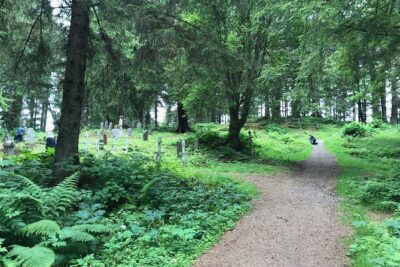
Next you head to Hofgarten, a park on the edge of Munich’s old town. It was laid out in the 17th century by Elector Maximilian I, inspired by an Italian Renaissance garden. Historically, it was a place reserved for the high class—dukes and electors—so it carries a sense of old privilege.
The app nudges you to notice the atmosphere: benches, leaves moving in the wind, the soft garden feeling. Then the mood flips to questions about darker secrets. Even if you’re not hunting for “ghosts,” the experience makes you slow down and actually read the space.
Stop 3: Theatine Church of St. Cajetan (baroque contrast inside)
This checkpoint is Theatinerkirche St. Kajetan (Theatine Church of St. Cajetan). It was built in the mid 17th century by Elector Ferdinand Maria and his wife Henriette Adelaide, honoring the birth of the long-awaited heir to the Bavarian throne.
The game asks you not to settle for the façade. The contrast matters: the outside is bright and the interior is ornate white. Then you’re steered toward the next clue inside the church, so you’re not just admiring the baroque style—you’re using it to solve the story.
Note: the listed admission for this stop is not included, so decide whether you’ll pay to go in before you start.
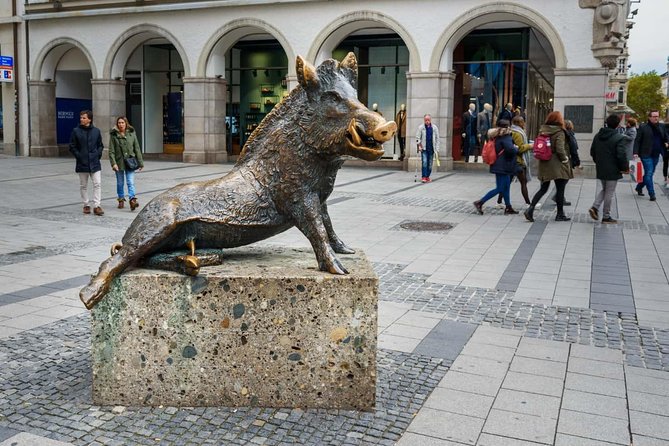
Stop 4: Sitzender Keiler (the Sitting Boar luck ritual)
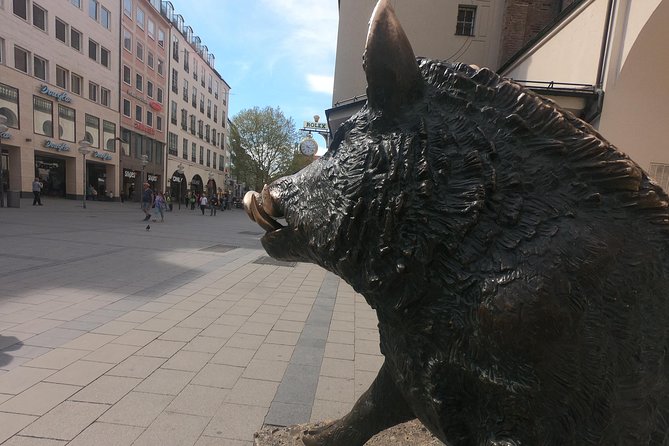
Now for a checkpoint with a more playful spooky vibe. Sitzender Keiler, also called the Sitting Boar, stands at the entrance to the Hunting and Fishing Museum. The statue shows a pig resting its hind legs while perched on short front legs, as if watching something in the distance.
The game pushes you into a local superstition: rub its nose for luck. It’s the kind of small action that makes the walk feel interactive, not just observational. You’re also getting a quick “Munich personality” moment—this city has plenty of traditions and symbols like this.
This stop is marked free, so you can enjoy the ritual without worrying about entry costs here.
Stop 5: Frauenkirche (the devil’s footprint at the entrance)
You’ll reach Frauenkirche with its famous twin towers around 100 meters tall. It’s one of Munich’s best known landmarks, and the interior is known for detailed vaulted ceilings and long stained-glass windows.
But the haunted angle is the legend connected to the entrance. The game references a story about the builder making a bet with the Devil that the church would have no windows. When the Devil realized he’d been tricked, he left a footprint.
This stop is where the game gets more myth-based. You’ll be encouraged to solve the challenge to understand the full story tied to that legend.
Again, admission is not included for this stop, so plan for potential ticket costs if you want interior access.
Stop 6: Marienplatz (where city power and chaos meet)
Marienplatz is the center of the action—Christmas markets, celebrations, and major events like FC Bayern moments. The square has been central since Munich’s founding under Henry the Lion in the 12th century, when important streets met and tournaments were organized.
The app treats it like a living stage. It asks what happened here and pushes you to answer a question tied to the energy of the square. This checkpoint is useful because it turns a “just walk through it” space into a problem-solving stop.
This stop is listed free, so it’s one of the easiest checkpoints to keep cost low.
Stop 7: St. Peter’s Church (800 years of rebuilds)
At St. Peter’s Church, you’re looking at Munich’s oldest Catholic church and a key city symbol. The building survived fires and wars over roughly 800 years, and because it’s been reconstructed so often, you’ll see a mix of styles—Gothic, Baroque, and Rococo.
The big incentive here is the tower climb. The game includes the payoff: a bird’s-eye view after climbing 299 steps. That’s a real activity moment, not just a story beat.
Admission for this stop is not included, so if you’re budgeting, treat the tower climb as the potential extra cost you’ll need to decide on.
Stop 8: New Town Hall (Neus Rathaus) and the final clue)
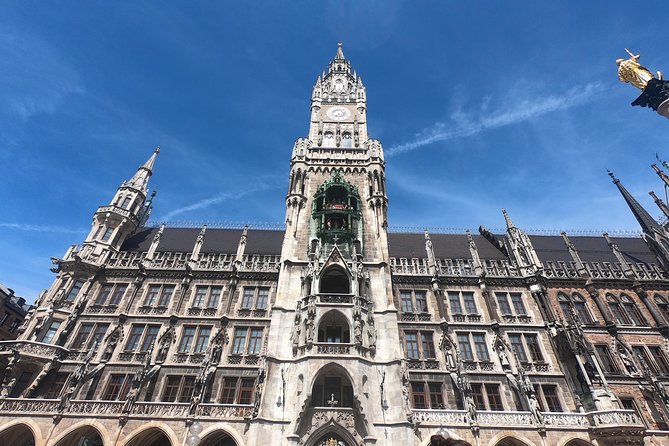
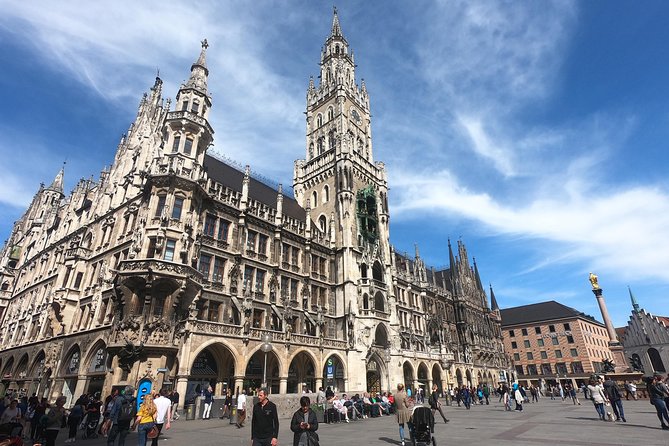
Your final destination is the New Town Hall (Neus Rathaus), home to city politics and meetings—and famously, a balcony spot that relates to FC Bayern celebrations. The game uses the building’s public spectacle energy, including the Glockenspiel that attracts audiences.
It also includes a plague-era story about barrel makers being among the first to step back out and dance for people scared by disease. Your “final clue” involves dancing your way toward the solution, and yes, it even frames it as calling yourself a true Questo explorer.
Admission for this stop is not included, so decide whether you want to include any paid access elements at the end.
Offline play: how it changes the experience

The offline feature is a big deal in practice. When you’re walking among old stone streets and busy squares, you don’t want to spend mental energy thinking about network bars. With offline access, you’re freer to:
- start even if you don’t have data on hand,
- keep walking without sudden refresh glitches,
- spend your attention on faces of buildings and small details the game nudges you to notice.
If you can, plan to have your phone charged enough for an hour or two. That’s the one “tech” reality check with any mobile experience.
Crowd control without a guide breathing down your neck
This is a private, self-guided activity. That does two things well:
- You can linger when a spot is interesting.
- You can move on quickly if it’s crowded.
It’s not a “tour group bottleneck” model. And because the checkpoints are time-boxed (many are around 10 minutes), you’ll keep momentum without feeling rushed.
If you’re the type who likes photos but hates waiting, this format helps.
Best for families, couples, and small groups who like to look closely
The highest praise from the experience format fits a certain traveler style: people who enjoy teamwork and paying attention to details. One family-style use case makes sense—this kind of game naturally becomes a shared challenge between adults and teens because everyone gets a role in spotting what the story is pointing at.
You’ll likely enjoy it if:
- you like puzzles or scavenger hunts,
- you enjoy church interiors and public squares,
- you want a structured walk without locking into a live guide,
- you’re traveling as a couple or small group and want flexibility.
If you want only deep historical lectures, this may feel too short and too game-y. But if you want a fun way to make landmarks matter, it’s a clever approach.
When you might hit friction

There are two practical points to keep in mind.
First: tickets. Several major stops list admission as not included (churches and the town hall area, plus the tower at St. Peter’s). If your plan is strictly low-cost and you prefer only free entry, you may enjoy the “outside” moments but miss some of the story payoff.
Second: tech issues. One shortcoming noted is that the experience didn’t work for at least one buyer and there was confusion about being charged. If anything feels off at the start, contact support quickly. The provider’s support email listed for problems is [email protected].
Quick FAQ
FAQ
Is the Ghosts of Munich game available in English?
Yes. The experience is offered in English with audio stories.
Can I play it without a physical guide?
Yes. It’s private and self-guided, so there’s no physical tour guide included.
Does it work offline to avoid data charges?
Yes. The game can be accessed offline, which helps you avoid expensive phone data charges.
How long does the experience take?
It’s listed as about 1 to 2 hours.
Are all entrance tickets included?
No. Several stops are marked as not included (for example, some church stops and St. Peter’s tower). Other checkpoints are free.
Can I start at any time and take breaks?
Yes. You can start at any hour and pause for breaks, then resume later.
Should you book Ghosts of Munich?
If you want a low-cost, self-paced Munich walk that keeps you looking up and looking around, I’d book it. The offline feature and English audio make it easy to run without stressing over connectivity or understanding every street sign. And the route hits the kind of central landmarks you’d probably visit anyway, which helps the price feel fair.
I’d hesitate only if you’re determined to keep every stop free, since multiple major entries are not included. Also, if your phone access is unreliable, treat this like an app-dependent activity: charge up, test your setup before you start, and be ready to get help fast if something doesn’t load.
Overall: for families, couples, and small groups who like a little mystery with their sightseeing, this is a smart way to make Munich feel like a story you’re actively solving.